How Much Home Can You Afford? A 2026 Guide for Canada and the US
- TrueNorthCalc Team
- Jun 19
- 4 min read
How much home can you actually afford?
Affordability is not about the largest mortgage a calculator will show you — it is about what a lender will actually approve based on your income, your existing debts, and your down payment. Because Canada and the United States qualify borrowers differently, this home affordability calculator applies the correct rules for each. In Canada it uses the Gross Debt Service (GDS) and Total Debt Service (TDS) ratios with the federal stress test; in the US it uses the standard 28/36 debt-to-income guidelines. From the maximum monthly payment you would qualify for, it works backward to the maximum home price you could realistically buy.
There is an important distinction between the most a lender will approve and the most you should comfortably borrow. Qualifying ratios are an upper limit, not a recommendation. Buyers who borrow right up to their maximum often end up "house poor" — technically able to make the payment but with little left for savings, travel, or the repairs that come with owning a home. A good practice is to calculate your maximum, then deliberately shop below it so a rate increase at renewal or an unexpected expense does not put your budget under strain.
The Canadian rules: GDS, TDS, and the stress test
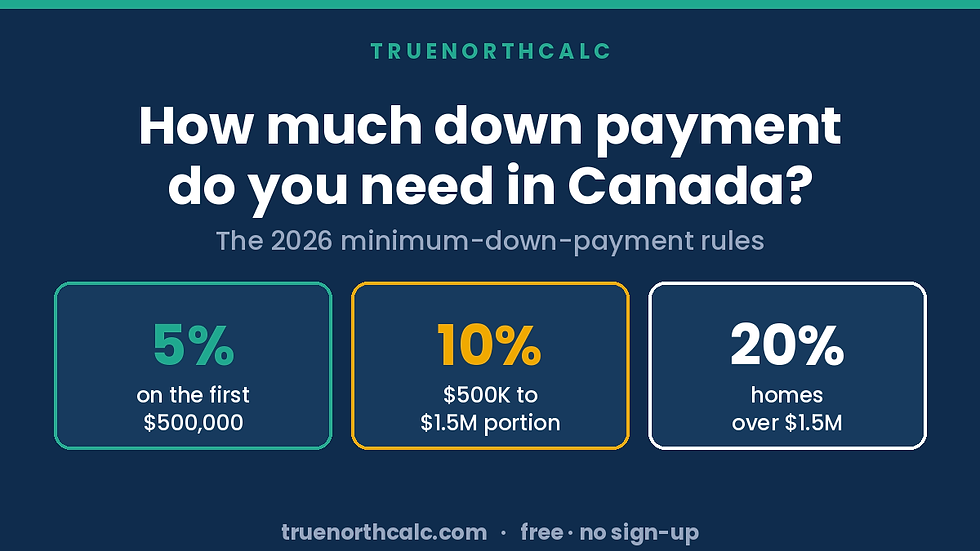
Canadian lenders cap housing costs at roughly 39% of gross income (GDS) and total debt payments at about 44% (TDS). Housing costs include your mortgage payment, property tax, and heating; TDS adds car loans, student loans, credit-card minimums, and lines of credit. Whichever limit you hit first sets your maximum. Federally regulated lenders also apply a stress test: you must qualify at the higher of your contract rate plus 2% or 5.25%. Down payments under 20% require CMHC insurance, with a minimum of 5% on the first $500,000 and 10% on the portion above, and homes priced at $1.5 million or more cannot be insured.
The US rules: the 28/36 guideline
Most US lenders follow the 28/36 rule: housing costs within about 28% of gross monthly income (front-end), and total debt within about 36% (back-end). Some programs stretch the back-end to 43% or higher. Putting down less than 20% usually means paying private mortgage insurance (PMI) until you reach 20% equity. Because the US front-end limit of 28% is stricter than Canada's 39% GDS ceiling, the same income often supports a smaller mortgage in the US than in Canada.
A worked example
Imagine a Canadian household earning $120,000 a year, or $10,000 a month gross, with a $600 monthly car payment and a 20% down payment saved. At a 39% GDS limit, roughly $3,900 a month is available for housing, but property tax and heating take a slice, leaving perhaps $3,300 for the mortgage payment itself. The stress test then requires that payment to work at around 7% rather than the roughly 5% you might actually get. At 7% over 25 years, $3,300 a month supports a mortgage of about $467,000, which with the down payment points to a home price near $584,000. At the real 5% rate, that same mortgage costs only about $2,720 a month — so the household has built-in breathing room, which is exactly what the stress test is designed to create.
What moves your number up or down
Four inputs do most of the work. Paying down or eliminating other debts frees up room under the TDS or back-end limit and can raise your maximum quickly — clearing a $600 car payment can add tens of thousands to the home price you qualify for. A larger down payment increases your price ceiling and, past 20%, removes mortgage insurance. A longer amortization lowers the qualifying payment and lifts the maximum, at the cost of more lifetime interest. And the rate matters: because the Canadian stress test qualifies you at a higher rate than you will actually pay, your real payment will usually sit comfortably below the maximum the calculator shows.
Frequently asked questions
What is the mortgage stress test?
Federally regulated Canadian lenders must confirm you could still afford your mortgage if rates rose. You have to qualify at your contract rate plus 2%, or 5.25%, whichever is higher. The calculator uses that higher rate to set your maximum price, then shows your estimated payment at the actual rate you entered.
How much down payment do I need?
In Canada the minimum is 5% on the first $500,000 of price and 10% on any portion above, up to a $1.5 million insurable cap. In the US, conventional loans often allow as little as 3% to 5% down. Putting down less than 20% in either country means paying mortgage default insurance — CMHC in Canada or PMI in the US.
Should I borrow the maximum I qualify for?
Usually not. The qualifying ratios mark the edge of what a lender will allow, not a comfortable budget. Leaving a margin below your maximum protects you against rate increases at renewal, job changes, and the ongoing costs of ownership. Run the calculator to find your ceiling, then choose a target price with a deliberate cushion underneath it.
Ready to run your own numbers? Try the Home Affordability Calculator — free, no sign-up, on TrueNorthCalc.
Comments