FHSA vs the RRSP Home Buyers' Plan: Which to Use for Your Down Payment (2026)
- TrueNorthCalc Team
- Jun 22
- 4 min read
If you're buying your first home in Canada, two government programs can supercharge your down payment: the First Home Savings Account (FHSA) and the RRSP Home Buyers' Plan (HBP). They sound similar, but they work very differently, and in 2026 the smart move is to understand exactly when to use each.
The 30-second answer
Use the FHSA first, then the HBP if you still need more. The FHSA is the better deal: money goes in tax-deductible, comes out tax-free for a home, and you never repay it. The HBP is useful, but it's a loan to yourself that must be repaid over 15 years.
What each program actually is
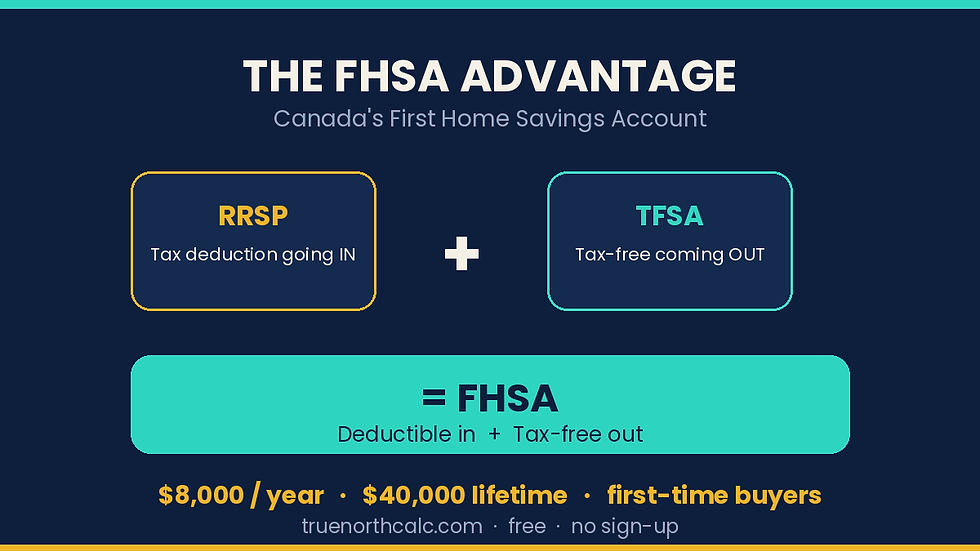
The FHSA is a registered account built specifically for first-home savings. You can contribute up to $8,000 per year, to a $40,000 lifetime limit. Contributions are tax-deductible like an RRSP, and when you withdraw for a qualifying home, the contributions and all the investment growth come out completely tax-free like a TFSA. There's no repayment, the money is yours.
The HBP isn't a savings account, it's a way to borrow from your own RRSP. In 2026 you can withdraw up to $60,000 from your RRSP tax-free to buy or build a first home (raised from $35,000 in 2024). The catch: you must repay that money into your RRSP over 15 years, starting the second year after you withdraw. Miss a yearly repayment and that portion is added to your taxable income for the year.
Head-to-head: FHSA vs HBP in 2026
Limit: FHSA is $40,000 lifetime ($8,000/yr); HBP is $60,000 per person.
Tax deduction going in: both yes (HBP is RRSP money).
Tax on withdrawal: FHSA none for a qualifying home; HBP none.
Repayment required: FHSA no; HBP yes, over 15 years.
What it is: FHSA a dedicated savings account; HBP a loan from your own RRSP.
If you don't buy: FHSA rolls into your RRSP tax-free; HBP money simply stays in your RRSP.
The single biggest difference: the FHSA is yours to keep, while the HBP must be paid back. That's why the FHSA wins when you can only choose one.
Why the FHSA usually comes first
No repayment. With the HBP you commit to putting roughly $4,000 a year back into your RRSP for 15 years on a full $60,000 withdrawal. That's money you can't use for anything else. The FHSA has zero repayment.
You keep the growth tax-free. Both accounts give the deduction going in, but only the FHSA lets the investment growth come out tax-free for your home. HBP money is just your existing RRSP savings.
A built-in safety net. If your home plans change, an unused FHSA rolls into your RRSP tax-free without using RRSP room. Nothing is lost.
When the HBP still matters, and how to use both
The HBP isn't a consolation prize. It shines in two situations:
You already have a sizeable RRSP. If you've contributed to an RRSP for years (or have employer-matched savings), the HBP lets you tap up to $60,000 of it for your home without triggering tax.
You need more than the FHSA can hold. The FHSA caps at $40,000. If your down payment goal is bigger, the HBP is the natural top-up.
And here's the key point a lot of buyers miss: you can use the FHSA and the HBP on the same purchase. Max your FHSA first, then withdraw from your RRSP under the HBP for the rest.
How much can a couple pull together?
If both partners are first-time buyers, each gets their own FHSA and their own HBP:
FHSA: $40,000 x 2 = $80,000
HBP: $60,000 x 2 = $120,000
Combined: up to $200,000 toward a first home, most of it with a tax deduction going in and zero tax coming out.
That's potentially a 20% down payment on a $1,000,000 home, assembled almost entirely inside tax-advantaged accounts.
A quick worked example
Say you've maxed your FHSA at $40,000 and also have $30,000 in an RRSP you're willing to use. You buy a first home and:
Withdraw the full $40,000 FHSA, tax-free, nothing to repay.
Withdraw $30,000 under the HBP, tax-free now, but you'll repay roughly $2,000/year into your RRSP for 15 years, starting the second year after withdrawal.
Total toward your down payment: $70,000, with only the $30,000 HBP portion carrying a repayment obligation. Solo, with a $40k FHSA plus $60k HBP, you could reach $100,000 on your own.
How this fits your bigger plan
These accounts decide how you fund the down payment. Your target home price decides how much you actually need, and in Canada that's driven by the GDS/TDS ratios and the mortgage stress test, not just your savings. To see the price you'd realistically qualify for, run your numbers in our free home affordability calculator. And to figure out how much you can set aside each month, our take-home pay calculator shows your real after-tax income by province for 2026.
Bottom line
For a first-time buyer in 2026: fill the FHSA first (deductible in, tax-free out, no repayment), then use the HBP ($60,000) to top up if you need more, and remember you can use both on the same home. As a couple, that's up to $200,000 working in your favour. Open your FHSA as early as you can so the contribution room starts building, and treat the HBP as the powerful backup it is.
This article is general information, not financial advice. Contribution and withdrawal limits and repayment rules can change, confirm the current figures with the Canada Revenue Agency or a qualified advisor before acting.
Comments