FHSA Explained (2026): How Canada's First Home Savings Account Works
- TrueNorthCalc Team
- Jun 20
- 4 min read
If you're saving for your first home in Canada, the First Home Savings Account (FHSA) is probably the most powerful account you can use in 2026 — and a lot of people still haven't opened one. It combines the best feature of an RRSP (a tax deduction going in) with the best feature of a TFSA (tax-free money coming out). Here's exactly how it works, what you can contribute this year, and how to decide if it's right for you.
What the FHSA actually is
The FHSA is a registered account designed for one job: helping first-time buyers save for a down payment faster. It launched in 2023 and has quickly become the default starting point for would-be homeowners — because it's tax-advantaged on both ends. Money you put in is tax-deductible, just like an RRSP contribution, so an $8,000 contribution lowers your taxable income by $8,000 for the year. And money you take out for a qualifying home purchase comes out completely tax-free, just like a TFSA withdrawal — your contributions and all the investment growth, with zero tax. No other account gives you both: an RRSP gives the deduction but taxes withdrawals, and a TFSA gives tax-free withdrawals but no deduction. The FHSA gives you both, which is why it usually comes first for a first home.
FHSA contribution limits in 2026
You can contribute up to $8,000 per year, up to a $40,000 lifetime limit — so the account is designed to be filled over about five years. If you don't use your full $8,000 in a year, you can carry forward up to $8,000 of unused room to the next year, which means the most you can ever contribute in a single year is $16,000. A quick example: if you opened your FHSA in 2025 but only put in $2,000, you carry forward the unused $6,000, so in 2026 your room is $14,000. One catch worth knowing — carry-forward room only starts building once you've opened an FHSA, so it's worth opening one even if you can't contribute much yet.
The double tax advantage, in real dollars
The deduction is worth more the higher your tax bracket. Contribute $8,000 at a combined marginal rate of around 30% and you cut roughly $2,400 off your tax bill for the year. Then, when you buy, the entire balance — contributions plus years of tax-free growth — comes out without a cent of tax. Many disciplined savers reinvest that refund back into the account, which is how the FHSA quietly compounds your down payment faster than a regular savings account ever could.
Who qualifies for an FHSA
To open and contribute, you generally need to be a resident of Canada, at least 18 (or the age of majority in your province) and under 71, and a first-time home buyer. "First-time" has a specific meaning here: you didn't live in a qualifying home that you or your spouse or common-law partner owned in the current calendar year or in the previous four calendar years. That four-year look-back surprises some people — if you owned a home years ago, you may well qualify again.
FHSA vs. the RRSP Home Buyers' Plan vs. TFSA
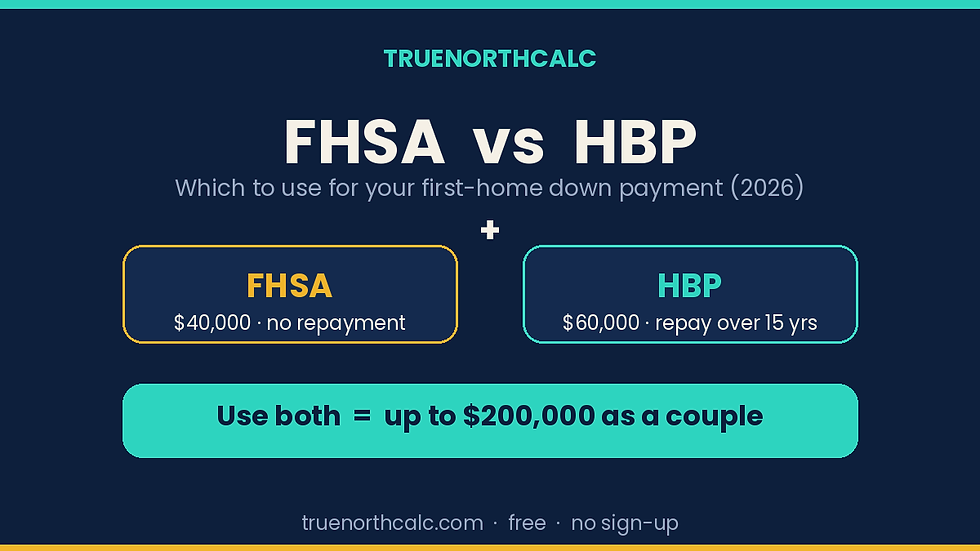
You don't have to pick just one — the strongest strategy often combines them. The FHSA usually comes first, because it's the only account with both the deduction and the tax-free withdrawal. Next is the RRSP Home Buyers' Plan (HBP), which lets you withdraw from your RRSP toward a first home — but unlike the FHSA, it's a loan to yourself that has to be repaid over 15 years. You can use the FHSA and the HBP together on the same purchase, which can mean a noticeably larger down payment. Once those are maxed, a TFSA is the natural next bucket: flexible, tax-free, and not restricted to a home. If you're weighing the bigger RRSP-versus-TFSA question for retirement rather than just a home, see our full breakdown: RRSP vs TFSA in 2026 — which one first?
What happens if you don't end up buying a home?
This is the FHSA's safety net, and it's a good one. If you don't buy a qualifying home, you don't lose the money — you can transfer your FHSA into your RRSP (or RRIF) tax-free, and it doesn't use up any of your RRSP contribution room. So in the worst case, your down-payment fund simply becomes extra retirement savings, with the tax deduction you already claimed still intact.
The 15-year clock
An FHSA can stay open for a maximum participation period of 15 years, or until the end of the year you turn 71, whichever comes first. Within that window you contribute, invest, and ideally make a qualifying withdrawal for your home. If the 15 years run out, you simply transfer whatever's left to your RRSP or RRIF. For most first-time buyers, 15 years is far more than enough.
How this fits into your down payment plan
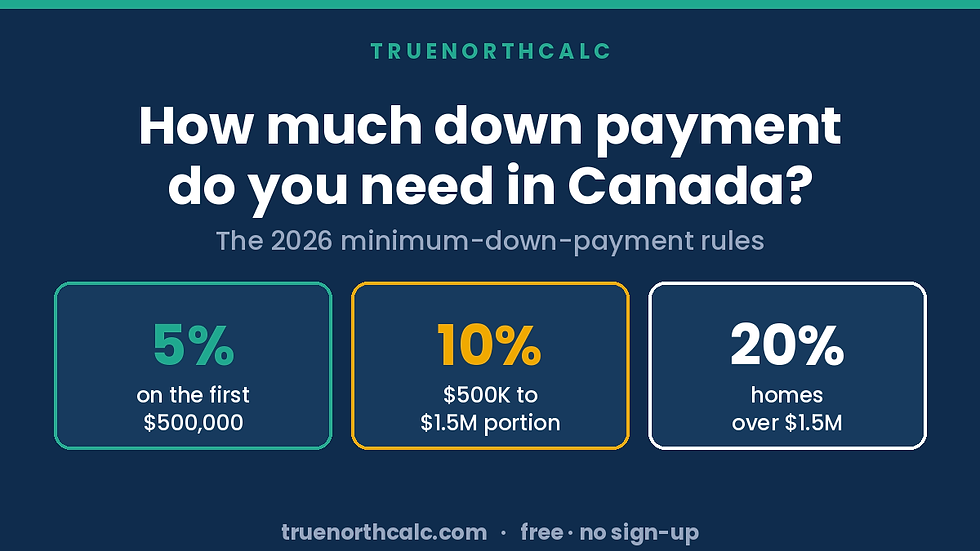
The FHSA decides how you save; your target home price decides how much you need. In Canada the minimum down payment is 5% on the first $500,000 of the price and 10% on the portion above that, and anything under 20% down requires CMHC mortgage insurance. The FHSA's $40,000 of lifetime room — or up to $80,000 for a couple, since each partner can have their own — lines up neatly with a 20% down payment on a starter home in many markets. To see the price you'd actually qualify for, using Canada's GDS/TDS ratios and the mortgage stress test, run the numbers in our free home affordability calculator. And to figure out how much you can realistically set aside each month, our take-home pay calculator shows your real after-tax income by province for 2026.
Bottom line
For a first-time buyer in 2026, the FHSA is usually the single best place to start: an $8,000-a-year, $40,000-lifetime account that's tax-deductible going in and tax-free coming out, with a built-in safety net if your plans change. Open one as early as you can — even a small contribution — so your carry-forward room starts building, then pair it with the Home Buyers' Plan when you're ready to buy. You'll reach your down payment meaningfully faster than with a regular savings account.
This article is general information, not financial advice. Contribution limits and rules can change, so confirm the current figures with the Canada Revenue Agency or a qualified advisor before acting.
Comments