How Mortgage Payments Work: Canada vs the United States
- TrueNorthCalc Team
- Jun 19
- 4 min read
How mortgage payments work
A mortgage payment is built from two things: the size of your loan and the cost of borrowing it over time. This calculator takes your home price, down payment, interest rate, and amortization period and returns your regular payment, along with the total interest you will pay and the total cost of the loan over its life. It also handles a difference most calculators ignore — Canadian and American mortgages are not calculated the same way.
Every regular payment you make is split into two parts: interest, which is the lender's charge for the money you still owe, and principal, which actually reduces your balance. Early in the loan the balance is large, so most of each payment goes to interest and only a little to principal. As the balance falls the interest portion shrinks and more of each payment chips away at what you owe. This is why the first few years of a mortgage build equity slowly, and why putting extra money down early has an outsized effect on the total interest you pay.
Canadian versus American mortgages
In Canada, fixed-rate mortgage interest is compounded semi-annually, not monthly, by law. In the United States, mortgage interest compounds monthly. For the same posted rate, a Canadian mortgage carries a slightly lower effective monthly rate than an American one, so using a US-style formula for a Canadian mortgage overstates the payment, and vice versa. This calculator switches between the two methods automatically when you choose your country, so the number matches how your lender would actually compute it.
The gap is small on any single payment but it adds up over decades, and it is the reason you should never copy a US mortgage formula from a spreadsheet template to estimate a Canadian payment — it will quietly overstate your cost. Choosing the right country in the calculator applies the correct compounding so your estimate lines up with the figure your lender will quote.
A worked example
Suppose you buy a $600,000 home in Canada with 20% down ($120,000), leaving a $480,000 mortgage at 5% amortized over 25 years. Your monthly payment works out to roughly $2,790. Over the full 25 years you would pay about $357,000 in interest on top of the $480,000 you borrowed — meaning the home effectively costs around $837,000 in principal and interest, before property tax and insurance. Shorten the amortization to 20 years and the payment rises to about $3,150, but total interest falls by roughly $80,000. That trade-off — a higher monthly payment in exchange for far less lifetime interest — is the single most important lever most buyers overlook.
Amortization and how it shapes your payment
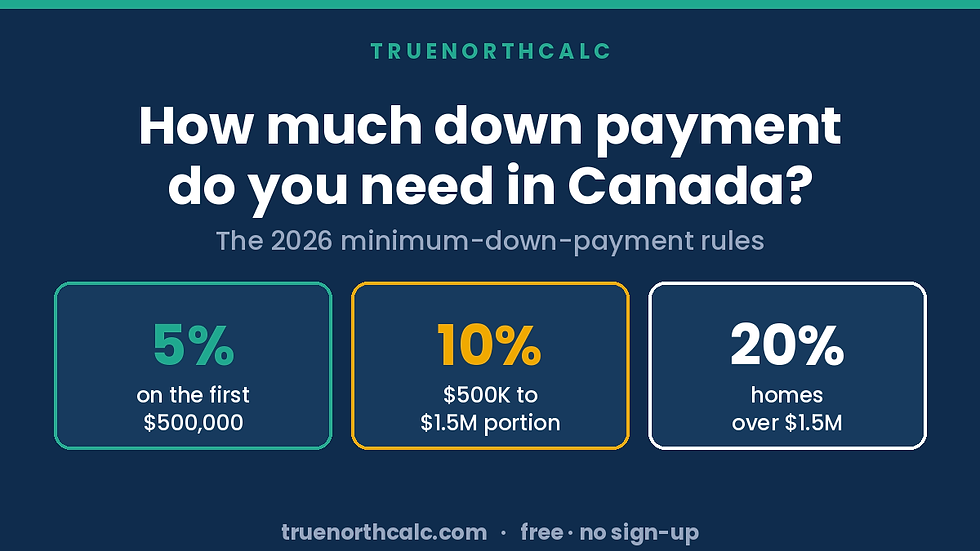
Amortization is the total length of time you take to pay the mortgage off — commonly 25 years in Canada and 30 years in the US. A longer amortization lowers each payment but increases total interest, because the balance shrinks more slowly. A shorter amortization means higher payments but far less interest overall. A larger down payment reduces the amount you borrow, lowering both your payment and total interest, and 20% or more lets you avoid mortgage default insurance.
The choice is genuinely personal. A longer amortization can be the difference between qualifying and not qualifying, and it leaves more room in your monthly budget for emergencies. A shorter one saves you tens of thousands in interest and builds equity faster. A practical middle path many borrowers use is to take the longer amortization for safety, then make occasional lump-sum or accelerated payments when cash allows — capturing most of the interest savings without locking themselves into a higher required payment.
Fixed versus variable rates
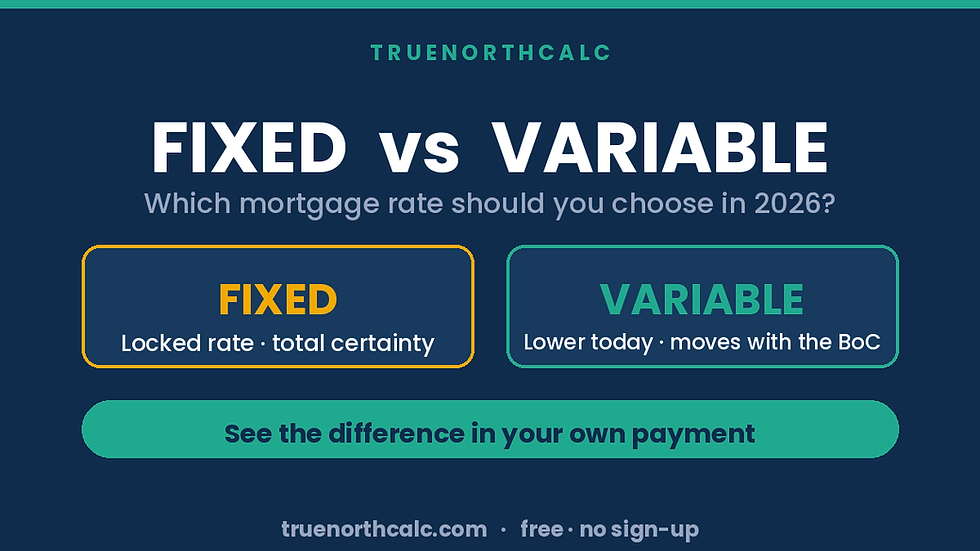
Your rate also depends on whether you choose a fixed or variable mortgage. A fixed rate stays the same for the term — typically up to five years in Canada, or for the full 15 or 30 years in the US — giving you predictable payments. A variable rate moves with your lender's prime rate, so your payment, or the share of it going to principal, can change as central-bank rates shift. Fixed rates trade a slightly higher starting cost for certainty; variable rates can save money when rates fall but expose you to increases. Whichever you choose, the payment math above still applies — only the rate input changes.
What the payment does not include
It is worth repeating that a mortgage payment calculator shows principal and interest only. Your true monthly housing cost also includes property tax, home insurance, mortgage default insurance if your down payment was under 20%, and condo or HOA fees where they apply. As a rough planning rule, budget an extra 1% to 2% of the home's value per year for tax and insurance combined, then add any condo fees on top. The principal-and-interest figure is the starting point for your housing budget, not the finish line.
Frequently asked questions
Why is the Canadian payment different from the US payment at the same rate?
Because Canadian fixed mortgages compound interest semi-annually while US mortgages compound monthly. For an identical posted rate, the Canadian effective rate works out slightly lower, so the payment is a little smaller. The calculator applies the correct compounding for whichever country you select.
Does this payment include property tax and insurance?
No — the calculator shows principal and interest only. Your real monthly cost will also include property tax, home insurance, any mortgage default insurance if you put down less than 20%, and condo fees where they apply. Treat the figure as the mortgage portion of your housing cost, not the whole thing.
Can I lower my payment without changing my rate?
Yes. A larger down payment reduces the amount you borrow, and a longer amortization spreads the balance over more payments — both lower the monthly figure. The trade-off is that a longer amortization increases the total interest you pay over the life of the loan. The calculator lets you test each of these instantly so you can see the effect before you commit.
Ready to run your own numbers? Try the Mortgage Payment Calculator — free, no sign-up, on TrueNorthCalc.
Comments